Buddhist Wisdom: 2,500 Years to Reach This Page

The Long Road of the Dharma — Why No Language Can Hold the Complete Truth
Twenty-five centuries, six languages, countless hands. By the time the teaching reaches us, the words are tired. Only sharp observing and discipline can reach what they were trying to point at.
Beginnings
Translators were incredible scholars, with incredible karma, and we are lucky they helped us the way they have. So that makes our karma lucky also to come into contact with it. We have to work hard as well. We cannot just read it one time and catch the meaning.
Why?
The Buddha did not speak English.
Contrary to social media one liners about Buddhist wisdom and over-simplified personal development hype: If true wisdom was so easy to find and learn and do, why even write it?
Why would the Buddha teach everyday for more than 40 years. Tens of thousands of sutras of philosophy classes. Even more summaries. And then summaries of summaries. If the wisdom was so easy, why would we have to do this?
Because it cannot be that easy.
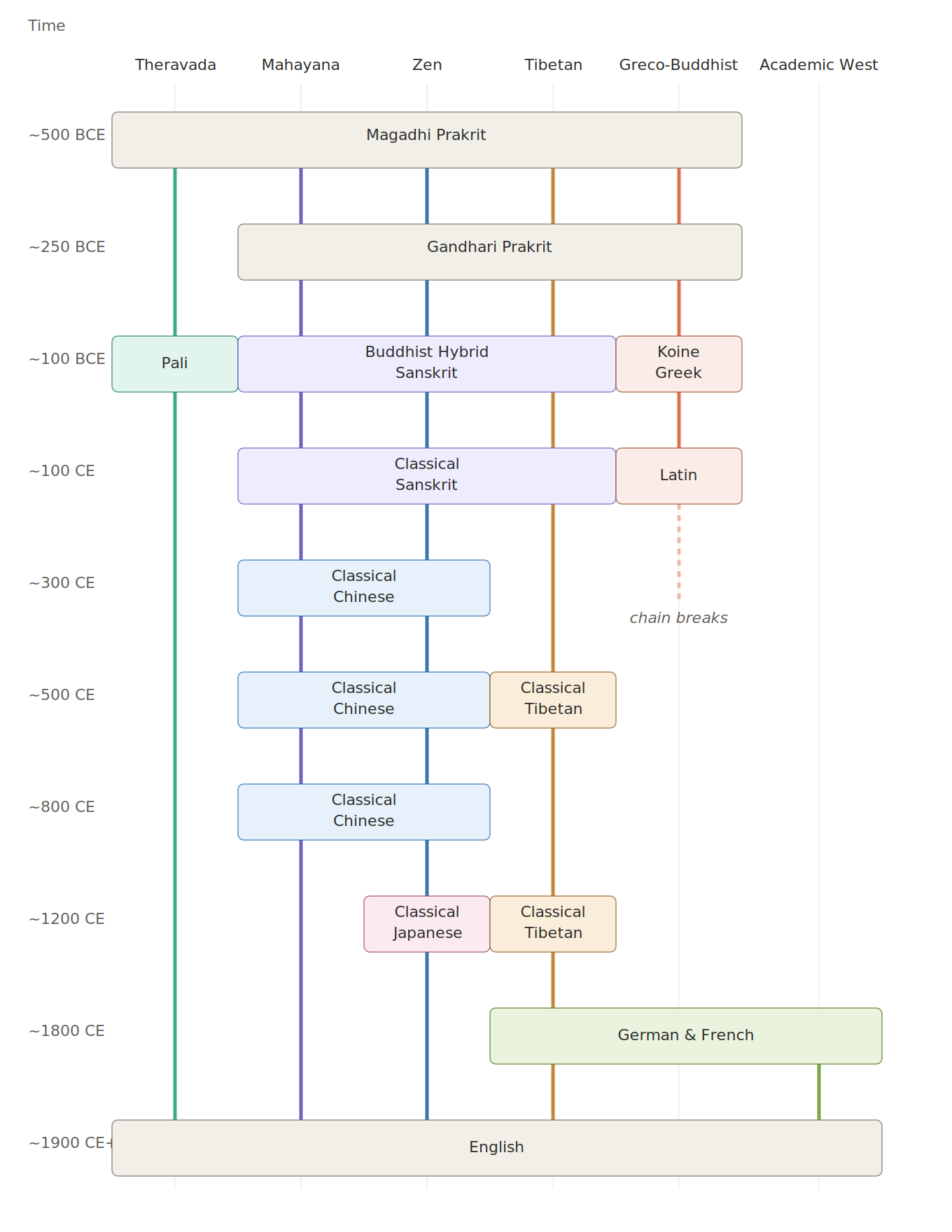
Look at the diagram above. It is not decoration. It is the route the Dharma had to walk to reach the page in front of you.
And this is incredible. Dharma Wisdom can pass through all the languages because it is beyond language.
The truth, remains the truth.
The Buddha did not speak English. But it is not clear if he spoke in Sanskrit either. He likely spoke in Magadhi Prakrit — a working language of north India in the Magadhra Region around 500 BCE — and for the first few centuries after his passing, his teaching was not clearly written down. It was carried in the bodies and breath of monks who memorised it.
From there, the road begins.
Theravada — the southern road
The teaching crossed into Pali around 100 BCE, was written down in Sri Lanka, and from there moved into Burma, Thailand, Cambodia, Laos. This is the closest line we have to the original sound of the Buddha's words. Even so, Pali is not Magadhi. Already, one translation has happened.
Mahayana — the northern road
The teaching moved through Gandhari Prakrit, then into Buddhist Hybrid Sanskrit, then Classical Sanskrit. From Sanskrit it crossed the Silk Road into Classical Chinese — three or four hundred years of translation work by monks like Kumarajiva and Xuanzang. Then from Chinese into Classical Japanese, into Korean, into Vietnamese.
Zen — a branch off Chinese
Zen is Chinese Chan that travelled into Japan around 1200 CE. So before a Zen text reaches English, it has been: Magadhi → Sanskrit → Classical Chinese → Classical Japanese → English. Five languages. Five sets of translator hands. I suspect it went through European languages German and French before it hit English. Another layer!
Tibetan — the high road
Tibetan translators around 800 CE did something unusual. They built a special form of Classical Tibetan precisely to receive Sanskrit Buddhist terms one-for-one. It is the most technically careful translation in the whole tree. But it is still translation. It has also not had the modern adjustment over time to relate the older words with meanings a different generation can understand. A balance that Chinese translators were instrumental in - mixing literal and modern words to find the true meaning AS a person of that time could understand.
Greco-Buddhist — the road that broke
There was once a fifth direction. The Buddha's teaching met the Greek world after Alexander, passed into Koine Greek, then Latin. It might have reached Europe two thousand years ago. The chain broke. Look at the dotted line on the right of the diagram. That is a road that closed.
Many Greek and Roman philosophers met Buddhist monks in their travels and their influence came back into their philosophy.
Academic West — the late arrival
German and French scholars in the 1800s began studying Sanskrit and Pali directly. English translations of the suttas and sutras did not really begin until around 1900 CE. From the Buddha to the first serious English Dharma book is roughly 2,400 years.
Why This Matters
Pick any school. Theravada, Mahayana, Zen, Tibetan. Every one of them reaches English through a chain of at least three or four languages, and every translator in that chain made choices.
They are limited by their own language. A chinese word has characters, so a word is a connection of many little stories together. But English has one word. Letters make up english words so might not caatch the depth of the chinese counter-parts.
But ancient chinese characters are that, ancient, and so difficult to find someone who can clearly grasp the meaning.
A word like dukkha becomes "suffering" in English — but dukkha is not suffering. It is closer to "unsatisfactoriness, the friction of impermanence rubbing against a self that wants permanence." One English word cannot carry that.
A word like śūnyatā becomes "emptiness" — but emptiness in English sounds like a void, an absence, something cold. Śūnyatā is not absence. It is the openness that allows everything to appear.
Multiply this by every key term. Multiply that by every sentence. Multiply that by every chain of translators across two and a half thousand years.
This is why studying Buddhism in English — no matter the school — is, in a sense, mission impossible. The medium is too thin. The road is too long. The words have lost weight along the way.
And Yet
And yet, here we are. Trying.
To even attempt to study the Dharma in English in this century is amazing karma. Most beings born across the last 2,500 years never had access to any of this. We have something — fragments, translations, lineages still alive in pockets of the world. The fragments are enough, if we are willing.
But willing to do what?
Willing to not stop at the words.
The words are pointers. The words have always been pointers, even in Magadhi, even in Pali, even in Sanskrit. The Buddha himself said his teaching was a raft — useful for crossing, not to be carried on the head once you reach the other shore. If even the original words were a raft, what are five-translations-deep English words? They are a sketch of a raft. They are notes for a raft.
So the truth was never going to come from the page. Not for anyone, in any century, in any language. The page was always a doorway, and the doorway is narrow.
What Reaches Through
Because true ability can only come from the right cause - true observing.
And I can only do the true observing for myself. And you for yourself. That is why it can lead to true wisdom.
Correct cause, correct result.
What reaches through every language, every translation, every lost nuance, is something the words were always pointing at and never were.
That something is reachable only by sharp observing and discipline.
Sharp observing — watching the heart, watching the breath, watching the rise and fall of every thought, watching how suffering is built moment by moment inside our own consciousness.
Discipline — the willingness to keep observing when it is boring, when it is painful, when nothing is happening, when everything is happening, when the ego pulls you back into its old story a thousand times a day.
No language carried the truth. No school holds the truth in its words. The truth of life is only ever discovered, never received. That is what makes it real. That is what makes it powerful.
The diagram shows you 2,500 years of effort. Monks, translators, lineage holders, scholars — all of them passing the raft along, knowing the raft is not the shore.
Now the raft has reached us. In English. Imperfect, thin, five-times-translated.
It is enough. If we observe. If we have the discipline. The truth is still here, waiting, in exactly the same place it has always been — not in the words, but in the looking.